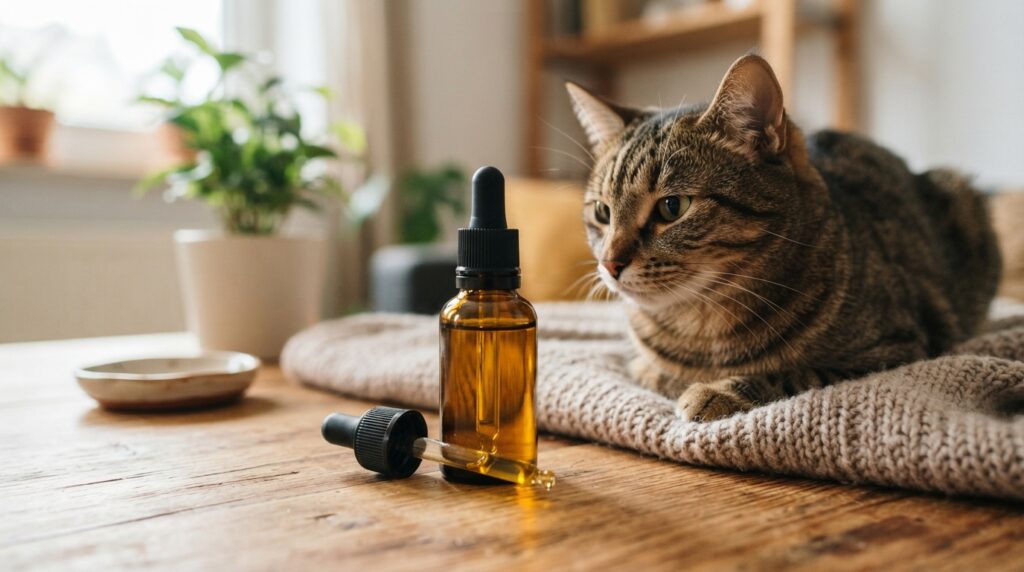
The vocabulary around hemp products can feel like a second language. Cannabinoids, terpenes, spectrum, isolate, bioavailability: each term appears on labels and websites, often with little explanation.
A short primer makes shopping calmer. People who understand the basics of CBD oil for cats spot weak claims faster and ask better questions of both sellers and veterinarians.
This guide covers the science in plain words, how to read research without getting lost, and where to find reliable information before any order is placed.
The Science in Plain Words
Cannabinoids and the Hemp Plant
The cannabis plant produces more than 100 cannabinoids, chemical compounds that interact with receptors in the body. The two best known are THC, which is intoxicating, and CBD, which is not. Hemp is a variety bred to contain very low THC.
Pet products rely on CBD extracted from hemp and blended into oil. Other compounds, such as CBG and CBN, may appear in small amounts, and terpenes, aromatic compounds that give plants their scent, can carry over too.
The Endocannabinoid System
Mammals, including cats, have an endocannabinoid system, a network of receptors and signaling molecules involved in functions such as appetite, pain signaling, and immune activity. Two main receptor types, CB1 and CB2, have been identified in a range of tissues.
That biology explains why cannabinoids interest researchers. It does not prove that a bottle from a store shelf will do something specific for a specific cat.
Absorption in Cats
CBD is fat-soluble, so oil carriers help with uptake. A 2019 paper in the journal Animals measured blood levels of CBD in healthy cats and dogs after a single dose of a hemp product, and found that absorption varied between animals and between formulations.
Variation matters because two cats given the same amount may end up with different blood levels. That is one more reason to avoid copying amounts from another owner.
THC and CBD Are Not Interchangeable
THC is toxic to cats, and signs can include dilated pupils, wobbling, vomiting, and slowed heart rate. CBD has a different profile, and reported side effects in animal studies tend to be milder.
Products made from hemp can still carry trace THC. A lab report with THC listed is the check that separates a careful product from a risky one.
Reading Research Without Getting Lost
Look at the Species
A study in dogs is not a study in cats. Many headlines about CBD and pets refer to canine trials, such as the 2018 Cornell study of dogs with osteoarthritis. Cats metabolize some compounds differently, so results cannot be assumed to carry over.
When a page cites research, check which animals were studied. Mouse or human results mentioned in a cat article should be labeled as such.
Count the Animals
Small studies can be useful for safety, yet they cannot show benefits that apply to all cats. A study of eight animals may reveal side effects while saying little about how well something works.
Sample size is usually in the first paragraph of the abstract. A quick look takes seconds.
Look for Controls
A placebo-controlled trial compares a treatment with a dummy substance, and ideally neither owners nor researchers know which cat received which. That design controls for expectation, which is strong in owner-reported outcomes.
A 2012 study in the Journal of the American Veterinary Medical Association showed how strong the placebo effect can be, with more than half of owners of placebo-treated dogs reporting improvement.
Check Who Paid
Funding does not invalidate a study, but it is worth noting. Research paid for by a product’s maker deserves the same scrutiny as any marketing, and independent replication adds weight.
A quick scan of the disclosures section usually shows who funded the work.
Practical Next Steps
Where to Find Reliable Information
Trusted starting points include:
- The FDA’s consumer pages on CBD and on pets
- The American Veterinary Medical Association’s resources on cannabis and animals
- PubMed, the free database of biomedical papers, for original studies
- Clinic websites and veterinary schools that publish client guides
- The ASPCA Animal Poison Control Center for toxicity questions
Commercial blogs, including this type of article, are best used as a starting point and checked against these sources.
A Sensible Timeline
Owners who plan ahead tend to do better. A week of reading, a vet visit, a few days to compare finalists, and a start date that avoids stressful events such as travel make a calm path.
Skipping the reading stage is the most common reason for impulse purchases that disappoint.
Questions to Bring to a Vet
A good list might include: Is this cat a reasonable candidate? Which tests should come first? Could it interact with current medications? What signs mean stopping? Are there options with better evidence?
Bringing the label and lab report turns the visit into a working session.